
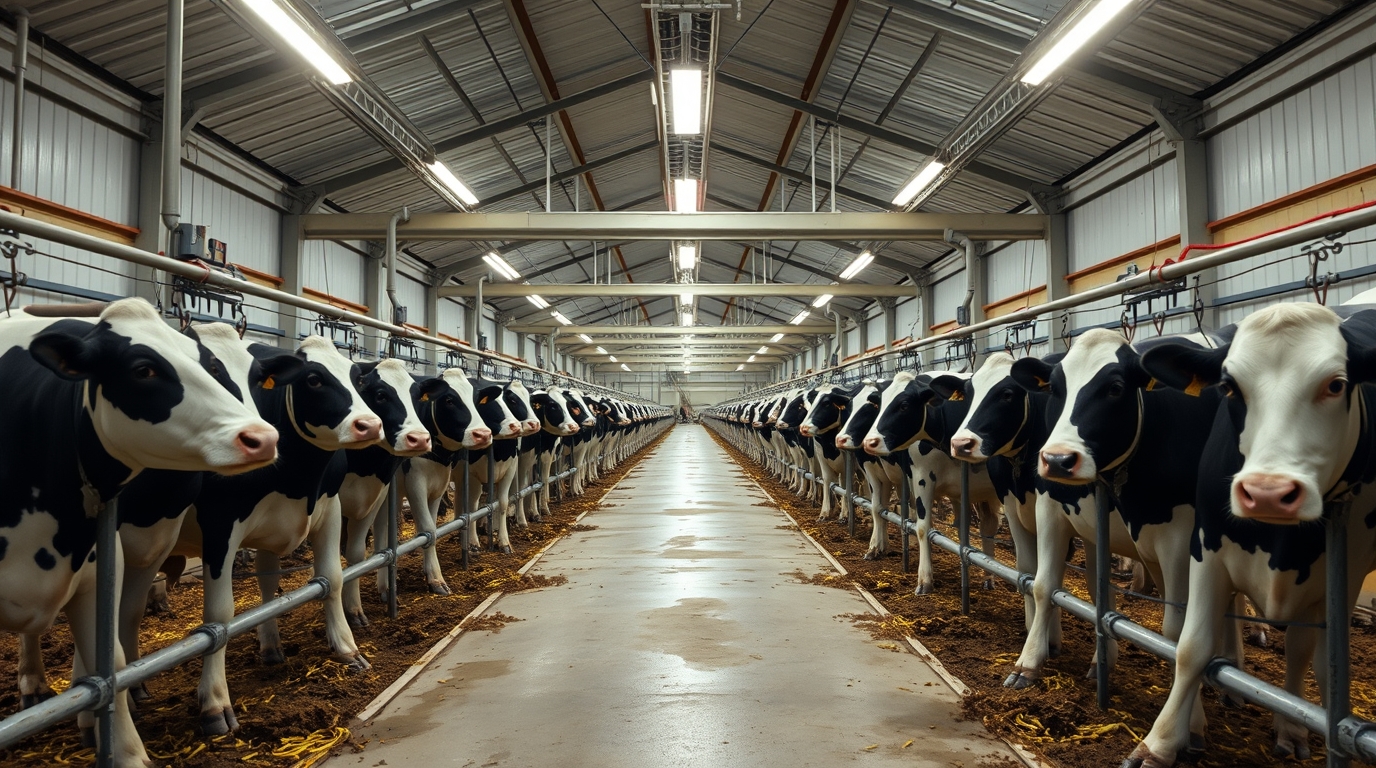
The US milk production 2026 surge reached 18.3 billion pounds in February, up 2.9 percent from February 2025, according to USDA data. The 24 major dairy states showed even stronger growth at 3.1 percent. Production per cow averaged 1,899 pounds for the month, up 12 pounds from the prior year. The story behind those numbers is the dairy herd itself. The national herd reached 9.62 million head — an increase of 211,000 cows compared to February 2025. The herd grew by 15,000 head between January and February 2026 alone. That puts the U.S. dairy herd at its largest level since 1993.
Phil Plourd, president of Ever.Ag Insights, called the rising cow count the defining characteristic of the report. Light slaughter and high retention are the primary drivers, he said. Those decisions reflect producer confidence and a massive wave of capital investment in new facilities. But the real engine behind the retention is a parallel market: beef-on-dairy crossbreeding, where dairy farmers breed cows to beef bulls and sell the resulting calves for prices around $1,400 per day-old black calf.
US milk production 2026 surge built on beef-on-dairy retention that carries long-term risks
The beef-on-dairy dynamic has created a feedback loop. Dairy farmers are holding cows longer than they normally would to generate another calf or two at premium beef values, rather than culling them at the usual stage of their productive life. That keeps cow numbers high and milk output elevated. But it also means the industry is not replacing cows with well-selected heifers at the same rate it once did. Sarah Jungman of AgMarket.Net has warned that when these retained cows eventually must be culled, there will be few heifers ready to take their place — a structural gap that could create a sudden supply contraction several years from now.
The short-term effect on milk markets is a well-supplied, price-pressured environment. Mike North, president of the Producer Division at Ever.Ag, said the abundance of raw milk has put downward pressure on cream prices across the country. The spring flush — the period of peak seasonal production — could be one of the most productive in U.S. history given current cow numbers. USDA has already lowered its all-milk price forecast for 2026 to $18.25 per hundredweight, down from a prior estimate of $18.75 and significantly below the roughly $21 average seen in 2025. For comparison, the same forces driving dairy supply growth are running in opposite directions from the beef cattle market, where the herd is at its smallest since 1951. Agroinformacion covered why ground beef prices will not return to normal levels before 2028.
Processing investment and export demand are absorbing the US milk production 2026 surge so far
The industry has so far managed the volume increase through two channels: processing investment and exports. The U.S. dairy sector has seen roughly $10 billion in new processing capacity added across the 2023-2026 period. Export demand has also been absorbing surplus volumes. Four of the 12 months in 2025 saw record-high cheese exports. Butter exports hit a record in November 2025. Anhydrous milkfat exports reached a record in December 2025. Per-capita domestic dairy consumption has also risen, with Americans consuming an average of 661 pounds of dairy per person per year — the highest ever recorded.
Nate Donnay, director of Dairy Market Insight at StoneX, noted that February 2026 production growth of 2.9 percent already represents a deceleration from late 2025 rates. If cow numbers stabilize and per-cow gains remain modest, total milk production growth could ease to below 1 percent year-over-year by August. The question for the industry is whether processing capacity, export channels, and domestic demand can continue to absorb the volume without forcing sustained price weakness. The original analysis was published by Dairy Herd Management.